

Friday, May 18, 2012
Sand Wash Wild Horses

Thursday, April 26, 2012
Southwest and Florida Travels

I was lucky enough to get away for a few weeks to the beautiful desert southwest for some sun, horses and photo ops in early March. It was great to meet up with Bev Pettit and share her world for a few days. She was kind enough to share her home and horses and even got me back on a horse on the very kind and patient (and handsome) Skeeter. That is Skeeter the gray guy in some of the photos! The weather and light could not have been more perfect for our fun and games! In the Phoenix area I attended the Casa Grande Ranch Rodeo, the Scottsdale Arabian Show and Mounted Shooting at the Winter Range. I also met up with my friend Scott Trees and Sombrero friend Johnny Garcia showed us some team sorting. Scott even got to try his hand on the game little mare “Oprah”!
In New Mexico I met up with Lynne Pomeranz and got the whirlwind tour of wild horses and sanctuaries, caught a gallery and talked horses and photography. We visited the Monero Mustang Sanctuary in Northern New Mexico run by Sandy Claypool as well as the Cimarron Sky Dog Sanctuary in Watrous run by Jackie Fleming. These women are on the front lines of the continuing wild horse issues. After my trip to Nevada (see below) I saw very clearly the challenges we who love the horses are facing. Jackie explores the issue in depth, please take the time to read her blog for a better understanding.
I landed in a snowy, wintry Reno and spent a few days traveling in that area. The Palomino Valley BLM Wild Horse and Burro Holding Facility, just 12 miles north of Reno, had 1800 horses and burros in its pens the day I was there. The people in the office were open to answering my questions and letting me take photographs. While the handling of the wild horses by the BLM is a controversial issue, it also reminded me of the fact that approximately 45,000 mustangs and burros are currently in short and long term holding facilities in the US. Like it or not if we love these wonderful creatures we need to stop bickering and fighting amongst ourselves and complaining about the BLM and make an effort to work together to do what is best for the horses. A good place to start is considering adoption and promoting adoption events when they are in your area. I will have room in my barn for a burro or two the next time there is an adoption event in my region!
I also explored the Virginia Range and Damonte Ranch areas. These horses are not on BLM lands and not managed unless they stray into populated areas and create a nuisance. In addition, people have started feeding these horses so now as many as 100 horses stand close to housing developments waiting for handouts every morning. Some of the older pregnant mares are in extremely poor condition and it worries me that the horses are bound to lose in this situation.Read more about my visits to this area and my thoughts on the wild horse "problem" in my blog and view all my Southwest Galleries.

I was home for a week and then off again for Florida where I organized two photo workshops for German Equine Photographer Gabriele Boiselle. The weather was perfect and we were treated to some of the best and brightest horses and riders in the Wellington area. This is THE place for horse people to be during the winter months. From dressage to polo to Iberian horses and portraits I came home with many thousands of images to edit! View all the galleries from my Florida trip here
Friday, March 30, 2012
The Wild Horse "Problem"

I have to admit that before my trip to Nevada I was not aware of the scope and scale of the wild horse "problem". I had seen the horses on some of the ranges in Colorado and Wyoming and these vast ranges and the good health of the horses there lead me to believe that the ranges could support them without human intervention. While this may be true on some of the ranges what I saw in Nevada has changed my thinking. We hear so much about the wild horses on BLM lands that are rounded up and in the holding pens waiting for adoption (45,000-50,000 horses are in long and short term holding facilities at this moment with only a fraction of that number finding homes.)
But, there are horses other than the BLM wild horses in the west. There are Indian ponies that run on federal and state lands and could be classified as wild, and these days there are a growing number of horses that are being turned loose by owners no longer able to care for them and are left to fend for themselves. In addition, in Nevada there are what are termed the "estray" horses. These horses are not on BLM federal lands, but on state lands, and as many as 2,000 range in an area within 20 miles of the population center of Reno, with many other areas of Nevada also being home to wild horses on both state and federal lands. These horses are only "managed" when they start to become termed a nuisance and wander into territory that may have been theirs at one time but is now being developed by human beings. They may then be trapped and taken off the range, but there is no planned round up of these horses to keep their numbers so that the existing range can support them. While the BLM has never sent a horse to a sale where they may end up as meat on a hook, the horses on the state land do not enjoy this protection and when they are trapped out they could very possibly end up at a "killer" sale. While slaughter of horses no longer exists in the USA, horses are regularly shipped acorss the border to kill plants in Mexico and Canada.
But, there are horses other than the BLM wild horses in the west. There are Indian ponies that run on federal and state lands and could be classified as wild, and these days there are a growing number of horses that are being turned loose by owners no longer able to care for them and are left to fend for themselves. In addition, in Nevada there are what are termed the "estray" horses. These horses are not on BLM federal lands, but on state lands, and as many as 2,000 range in an area within 20 miles of the population center of Reno, with many other areas of Nevada also being home to wild horses on both state and federal lands. These horses are only "managed" when they start to become termed a nuisance and wander into territory that may have been theirs at one time but is now being developed by human beings. They may then be trapped and taken off the range, but there is no planned round up of these horses to keep their numbers so that the existing range can support them. While the BLM has never sent a horse to a sale where they may end up as meat on a hook, the horses on the state land do not enjoy this protection and when they are trapped out they could very possibly end up at a "killer" sale. While slaughter of horses no longer exists in the USA, horses are regularly shipped acorss the border to kill plants in Mexico and Canada.

The Nevada estray horses have a vast range but the factors of drought, loss of habitat and encroaching human development is taking it's toll. In addition local people have taken it upon themselves to feed these horses (which I believe is ILLEGAL) and now a group of as many as 100 horses wait on the edge of this development for their moring handout. While some of the younger horses in this group looked healthy I saw many many older mares (mostly pregnant) that looked extremely thin (starving). I have been disturbed by what I saw and I can say with confidence that this is going to get worse as the horses continue to grow in numbers while having less and less to eat. In my opinion, these horses do need to be managed. Is it more humane for a small group to thrive and be productive and healthy or for a large and growing group to slowly starve to death?

Look, I was only a visitor there for a few days, and I know there are groups to help the horses and I am not going to get into the BLM or slaughter debate with anyone. I don't claim to have all the facts, I am sharing what I saw and hope that for those of you that live far away from these ranges will learn from what I saw. Working for solutions rather than fanning the flames of controversy and propaganda against the BLM and the roundups is counter productive when we should be doing all we can to try to come up with viable solutions to help the horses. One thing you can do is support some of the great wild horse sanctuaries that take some of the horses from the holding facilities. With our support they can help more horses. I am sharing a list of reputable sanctuaries below. Get out to an adoption event and make room in your barn for a mustang or burro.
I have been thinking about this situation since my visit to Nevada and the horses in the holding pens will be something I will carry in my soul for the rest of my life. I hope that the BLM will work with the wild horse advocates and implement a policy of returning sterilized older horses to "zeroed" out Herd Management areas that can support these horses for the rest of their lives, and I also hope they will consider more humane methods to rounding up the horses. And I hope that the estray horses can be managed in such a way that the range can support their numbers, however I fear that their future looks bleak as long as people continue to encroach on their habitat and their numbers continue to grow.
My final wish is that as human beings we can do what is right for the horses.
Cimarron Sky Dog Sanctuary
Return to Freedom
Black Hills Wild Horse Sanctuary
Monero Mustangs
Cimarron Sky Dog Sanctuary
Return to Freedom
Black Hills Wild Horse Sanctuary
Monero Mustangs
Friday, March 9, 2012
Palomino Valley: 1800 Horses

“The greatness of a nation and its moral progress can be judged by the way its animals are treated”~ Ghandi
I was completely captivated by a pen of burros when I visited the Palomino Valley BLM Wild Horse and Burro Holding Facility north of Reno, Nevada last week. While the handling of the wild horses by the BLM is a controversial one it also reminded me of the fact that approximately 45,000 mustangs and burros are currently in short and long term holding facilities in the US. Like it or not if we love these wonderful creatures we need to stop bickering and fighting amongst ourselves and complaining about the BLM and make an effort to work together to do what is best for the horses. A good place to start is considering adoption. I will have room in my barn for a burro or two the next time there is an adoption event in my region! View more of my images from my visit to this facility here.
I will be sharing more photos from various wild horse ranges as well as sanctuaries shortly, please check back.
“I am a drinker of the wind
I am the one who never tires
I love my freedom more than all these things.
The Conquistador, Comanche and the cowboy
I carried them to glory
I am La Primera, Spanish mustang
hear my story”
~ Ian Tyson
Wednesday, February 1, 2012
Happy New Year and Early Spring Cleaning Special Offers
Special discount prices are now available on some of my favorite horse drive prints ready to be framed your way! Quantities are limited, first come, first served!
The 2012 Colorado Cowboys and Horses Calendar has been selling like hotcakes but there is still time to get your copy while they last. Check out the six calendar special edition with Horse Drive Calendars from 2006-2012 with many great photos from each year!
Bookmarks! I love seeing the world as a panorama and bookmarks are the perfect format for that. Now you can order some for your own enjoyment!
For my artist friends!
I get many requests from artists in need of good reference photos for their work. I have compiled an artists reference disk of 130 horse images specifically for this purpose. This is a royalty free, non exclusive disk of images for artists to use to as reference. On this disk you will find a great variety of sharp, clear images of horses from all angles: detail shots of ears, eyes, heads, noses, necks, legs, backs, manes, etc. You will also find horses in different gaits and poses: trotting, cantering, rolling, rearing, interacting and just standing or grazing. Click on the link above to view a slide show of all the images available on this disk.
The 2012 Colorado Cowboys and Horses Calendar has been selling like hotcakes but there is still time to get your copy while they last. Check out the six calendar special edition with Horse Drive Calendars from 2006-2012 with many great photos from each year!
Bookmarks! I love seeing the world as a panorama and bookmarks are the perfect format for that. Now you can order some for your own enjoyment!
For my artist friends!
I get many requests from artists in need of good reference photos for their work. I have compiled an artists reference disk of 130 horse images specifically for this purpose. This is a royalty free, non exclusive disk of images for artists to use to as reference. On this disk you will find a great variety of sharp, clear images of horses from all angles: detail shots of ears, eyes, heads, noses, necks, legs, backs, manes, etc. You will also find horses in different gaits and poses: trotting, cantering, rolling, rearing, interacting and just standing or grazing. Click on the link above to view a slide show of all the images available on this disk.
Wednesday, December 28, 2011
Year end thoughts: photography ramblings
As another year comes to an end I have been thinking about the state of photography in this technologically advanced world we live in. We have seen a real shift in the photographic world, and not all of it for the better. Recently we heard about CNN firing its freelancers because amateurs will work for free, and this is what a lot of us are up against.
Stock guru Jim Pickerell states that:
It paints a bleak picture for those of us trying to make a living at this, and in the horse industry we have seen some lively debates regarding the changing times of horse show photography with many photographers who once made a good living providing services as official show photographers no longer able to make it pay being up against poachers, "faux pros" and rampant image theft. Many of the publications and other image buyers who used to license images with us are now also turning to the cheaper option of royalty free and microstock.
While these issues will not be going away anytime soon I do believe that there will still be work for the high quality images, and those providing show services as well as stock images need to rethink their business plans.
Recently I went to an Ansel Adams exhibit and was struck by the preparation and planning and previsualization of each photo. In addition the technical details of each image, how he would carefully record the ISO, aperture, shutter speed and composition.
These days we see people buying expensive pro gear, setting it in auto mode and running their motor drive and calling themselves a professional photographer, but are really what would be considered a "faux pro". They have no concept of how their camera works, and in addition to that they are not legally running a business. They sell their images but they are not collecting or paying sales tax, have no business license and have no kind of liability insurance.
So you still want to make this a business? Then get your ducks in a row.
1. Learn what it takes to run a business.
2. Understand your camera and the basic concepts of photography. Take your camera out of auto mode and don't run your motor drive. Understand ISO, aperture, shutter speeds and how they relate to eachother.
3. Learn to edit. Be prepared to dump many images and only show your best work. Be your own toughest critic. Develop a thick skin. Always be open to critique, even though sometimes it may be hard to hear. Never stop learning.
4. Know your subject. Study work in periodicals and web sites. For horses learn breed standards and understand the trends and horse behavior.
5. Never say "it can be fixed in photoshop". Get it right in the camera. Over processed images will not save an image that was bad in the first place.
6. Treat your professional peers with courtesy and respect. Do not undercut them and do not infringe on their territory. The horse world is small, and word of mouth spreads quickly, networking with fellow photographers will get you further faster than trying to poach work from them. Building a network of like minded pros will serve as a support group and bring you work and more contacts.
7. Treat your good clients like gold. Reward loyalty. Fire clients that shop based on price or that expect free images or are never satisfied.
8. Offer quality products and great service. Offer items that they would not be able to produce themselves. Give them what they want at a price they feel is fair, and don't nickle and dime them to death. Be responsive, reliable and professional.
9. In this bad economy find a project that can be a way to give back. Work with a local group by donating your services to a cause you believe in. Sarah Andrews' Camelot Horse Calendar Project is a great example of how rewarding this kind of work can be.
10. Don't get discouraged. Work on developing your own style that is fresh, creative and YOU! Shoot for the plain joy of it!
Stock guru Jim Pickerell states that:
"The core business of providing pictures for commercial and consumer use has moved from hiring a professional photographer to shoot an assignment, to RM(rights managed) stock, to RF(royalty free) and then to microstock. The next paradigm shift will be iPhoneography"While we see uprisings, revolutions and occupations being documented via Iphone photos and video this will become the standard for how we get our news. In addition Pickerell writes about the the trend of image buyers now getting images from royalty free and microstock at a fraction of what they once paid, and the laws of supply in demand dictating a buyers market.
It paints a bleak picture for those of us trying to make a living at this, and in the horse industry we have seen some lively debates regarding the changing times of horse show photography with many photographers who once made a good living providing services as official show photographers no longer able to make it pay being up against poachers, "faux pros" and rampant image theft. Many of the publications and other image buyers who used to license images with us are now also turning to the cheaper option of royalty free and microstock.
While these issues will not be going away anytime soon I do believe that there will still be work for the high quality images, and those providing show services as well as stock images need to rethink their business plans.
Recently I went to an Ansel Adams exhibit and was struck by the preparation and planning and previsualization of each photo. In addition the technical details of each image, how he would carefully record the ISO, aperture, shutter speed and composition.
These days we see people buying expensive pro gear, setting it in auto mode and running their motor drive and calling themselves a professional photographer, but are really what would be considered a "faux pro". They have no concept of how their camera works, and in addition to that they are not legally running a business. They sell their images but they are not collecting or paying sales tax, have no business license and have no kind of liability insurance.
So you still want to make this a business? Then get your ducks in a row.
1. Learn what it takes to run a business.
2. Understand your camera and the basic concepts of photography. Take your camera out of auto mode and don't run your motor drive. Understand ISO, aperture, shutter speeds and how they relate to eachother.
3. Learn to edit. Be prepared to dump many images and only show your best work. Be your own toughest critic. Develop a thick skin. Always be open to critique, even though sometimes it may be hard to hear. Never stop learning.
4. Know your subject. Study work in periodicals and web sites. For horses learn breed standards and understand the trends and horse behavior.
5. Never say "it can be fixed in photoshop". Get it right in the camera. Over processed images will not save an image that was bad in the first place.
6. Treat your professional peers with courtesy and respect. Do not undercut them and do not infringe on their territory. The horse world is small, and word of mouth spreads quickly, networking with fellow photographers will get you further faster than trying to poach work from them. Building a network of like minded pros will serve as a support group and bring you work and more contacts.
7. Treat your good clients like gold. Reward loyalty. Fire clients that shop based on price or that expect free images or are never satisfied.
8. Offer quality products and great service. Offer items that they would not be able to produce themselves. Give them what they want at a price they feel is fair, and don't nickle and dime them to death. Be responsive, reliable and professional.
9. In this bad economy find a project that can be a way to give back. Work with a local group by donating your services to a cause you believe in. Sarah Andrews' Camelot Horse Calendar Project is a great example of how rewarding this kind of work can be.
10. Don't get discouraged. Work on developing your own style that is fresh, creative and YOU! Shoot for the plain joy of it!
Friday, December 23, 2011
Happy Holidays!
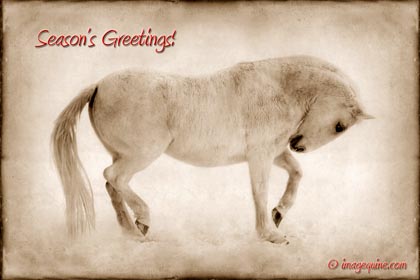
"May flowers always line your path and sunshine light your day. May songbirds serenade you every step along the way. May a rainbow run beside you in a sky that's always blue, and may happiness fill your heart each day your whole life through" ~ Irish Blessing
Happy Holidays and all the best for 2012 from all of us at ImagEquine and Thornapple Farm!
Friday, December 16, 2011
Chincoteague

Last weekend I spent some time in one of my very favorite places, Chincoteague Island in Virginia. It was an extra treat to share this special place with two photographer friends who could appreciate the peace and beauty of this special place. We saw some ponies, picked shells on the beach and enjoyed some brilliant sunsets over a pond full of thousands of snow geese as well as egrets, herons, ducks and ibis. The sunrise saw the geese take flight by the thousands and gather into their formations to head south, an awe inspiring sight. Nature is a great way to refresh yourself and help put this crazy world into perspective. Here is a gallery to the photos. As you can see this handsome young Palomino stallion spent quite a while grazing in view of our cameras and his color in the brown winter colors made for some great photo ops for us.
Friday, November 11, 2011
Putting Life into Perspective

Over my 53 years of life I have been fortunate with my health and never took my mobility for granted. Then on September 9 on a simple walk with my camera I slipped in a patch of mud and broke my ankle. Yes, life can change in an instant. This fall happened so quickly that I was not even able to save my camera, which was mashed right into the mud. Most photographers can relate to always holding their cameras up to save them when they fall. The first thing I told my husband when I made it to the house was to check my camera..take it from me, your camera can take a fall much better than you can!
In the midst of my busiest time of year I found myself sidelined in a cast and crutches with orders to allow my ankle to heal to avoid more problems. Even when things are bad, there is always a bright side: I received an email from a rider that had broken both ankles when doing an emergency dismount from a horse, and two other horse photographers broke their ankles at the same time, one of whom ended up in the hospital for 5 days and needed plates and screws, all a result of tripping over a cat. Another friend said to me, "Do you understand now how truly fragile you are?" Fragile? Me? Yes, I guess we all are when breaking one small bone can result in such a sudden lifestyle change.
My professional life has always been doing so many things at once, keeping so many balls in the air. Suddenly many of these balls were no longer an option, it was just not physically possible for me to juggle them. Gone was the option of walking, feeding my horses, driving, photographing several events or getting together with friends for a fun and much looked forward to weekend of photography. Each trip on the crutches, especially in the beginning had to be carefully planned. The crutches were the worst part of the whole ordeal, but I can say I got pretty good at getting around on them after a while. Then there were the daily trips for blood draws where I got wheeled around in a wheel chair. Seeing the world from the handicapped point of view was a real eye opener for me and I know I will always be more compassionate with people that have lost their mobility and meet these challenges on a daily basis.
As I allowed myself to heal my dogs were with me every moment. Many days I had two dogs and a few cats as close to me as they could be. My main dog Ollie refused to even go out to the barn (his very favorite activity in the world) for the first few weeks. Animal therapy is a real and very good thing. On one beautiful fall day I made the trek out to the barn and stood by the gate. The six horses all gathered around me and touched me so gently with their noses and muzzles. There was no pushiness, they just stood with me and I could feel their healing energy, it was a moment that I find hard to describe in words but from my many many years of being with horses it was a new bond and feeling I had never experienced until the moment I most needed it. Horses truly are healers.
Allowing myself to slow down I found myself more open to my friends, of whom I found many new ones in the virtual world and strengthened bonds with many old ones. Almost every day there was a phone call, or a note, or a gift, and this was a huge help to get me through each day. It seemed like just when I would start feeling the most sorry for myself a friendly voice or face would appear to snap me out of it! We truly have no idea in our fast paced world how much these little gestures of friendship and support mean, and I am truly grateful for all that were shown to me. On top of everything my husband and daughter took over all the day to day chores, and for that I am very grateful. There is nothing better than to know your family will pick up the slack!
I read many good books, and saw some movies I had wanted to see for a while (top picks: Out of the West, Buck, Driving Miss Daisy, The Real Dirt on Farmer John) and my thought processes have slowed to not being so scattered. I am working on getting my life's priorities more in order. There are some things that are truly important, and some things that maybe I really don't need to be doing.
The cast is off, the crutches are gone and walking is getting better each day. I am grateful for each little step. This week I was able to walk out to the barn with my camera and take some photos. Thank you again to everyone that sent your positive thoughts and energy, I know that it helped me in more ways than you can know. Along with the chocolate, photo, canine and equine therapy of course!
Wednesday, October 12, 2011
2012 Colorado Cowboys and Horses Calendar

The 2012 Colorado Cowboys and Horses Calendar are available for ordering!
Enjoy 13 months of 74 all new and exciting photographs featuring the horses and cowboys of Sombrero Ranch and the 2011 Great American Horse Drive in Northwest Colorado. Go here to see some preview pages and order your copy! View all the photos in the calendar at this slide show.
All the photos from the 2011 Horse Drive and workshop may be seen here.
NOTE: If you missed the 2011 Calendar go here take advantage of our sale! We also have a collection of five calendars available from 2007-2011 there.
Subscribe to:
Posts (Atom)
